What Time Is It, Mr. Fox?

Age-appropriate active games are a great way to help children grow and develop. They can challenge their mind while also challenging their physical fitness! One game your older preschooler or younger school-aged child can play with their friends is “What Time Is It, Mr. Fox?”
To play, your child will need at least 2 other friends to join the game. Have children play in a safe, open area. Choose one player to be Mr. (or Mrs.) Fox. The goal of the game is to get past the Fox without getting caught. To start, have the Fox stand about 20 feet away from the other players with their back turned to the other players. The players then say, “What time is it Mr./Mrs. Fox” The Fox responds with a certain time (whatever the Fox chooses) and the other players should walk forward that many steps. For example, if the Fox says it’s five o’clock, the players should take five steps (any size step) forward. This continues until the Fox responds to “What time is it, Mr./Mrs. Fox” by saying “Midnight!” At that point, the Fox chases the players back to the starting line trying to tag them. The first player that gets tagged by the Fox becomes the Fox for the next game.
To make the game more challenging and help children develop more physical skills, you can have them hop their steps on one foot or even skip forward. For more group games, visit http://m.kidshealth.org/en/parents/games-preschool.html and http://kidshealth.org/en/parents/school-age-games.html.
Who can your children play “What Time Is It, Mr. Fox” with?
Pico de Gallo – Homemade Salsa
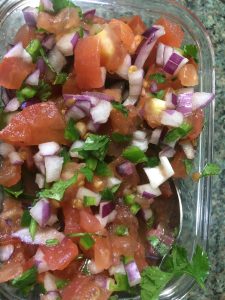
Ingredients:
- 2 Roma tomatoes diced
- ½ medium red onion diced
- 1 jalapeno cored and diced
- ½ cup chopped cilantro
- ½ teaspoon salt
Directions:
- Carefully dice and chop ingredients.
- Mix ingredients together in a bowl that can be tightly covered.
- Store in a covered container in the refrigerator.
Do You See What I See?

Regular exercise is essential to children’s physical development, but it’s also important to be mindful of their cognitive development. There are different developmental milestones children reach at different ages. These milestones are categorized into different types of development:
- Social/emotional
- Language/communication
- Cognitive (learning, thinking, problem-solving)
- Movement/physical
Games can be a great way to help your child reach these milestones. For example, preschoolers can benefit from games that help them learn their colors and understand their surroundings.
To improve your children’s health as well as cognitive development, go for a walk with your family and play the game “Do you see what I see?” Pick an object that everyone can see as you are walking. Without telling anyone what you are looking at, describe it and let everyone guess what it is. Take turns being the one to choose the object. Practicing observing and describing their surroundings through games like this can improve preschool-age children’s cognitive development. But no matter how old your child is, this is can be a fun game that also gets your family moving together.
A healthy diet is critical to all kinds of development, so make sure your children are eating nutritious fruits and vegetables, lean meats, beans, nuts and seeds, low-fat dairy, and whole grains to help them grow!
To learn more about child development, visit https://www.cdc.gov/ncbddd/childdevelopment/facts.html.
Where will you go to play “Do You See What I See?”
Make Up a Story and Act it Out

Imagination is an important part of childhood development. As children imagine new possibilities, they learn to think outside the box and solve problems in unique ways. This kind of thinking is critical to their cognitive development. While some adults struggle with creative thinking, children usually don’t! Children often have wild and active imaginations, so why not try putting those creative minds towards physical activity?
Allow each family member to make up a story. As they tell the story, everyone acts it out. You can pretend you are going to the beach, hiking up a mountain, or anything else you can dream up! Make sure to really exaggerate your movements to get the physical benefits of this activity. For example, take big steps as you pretend to hike up a mountain, and alternate arm movements as you pretend to rock climb.
Acting out stories is a great way to Move More, whether you play inside or outside! When the weather is too hold, cold, or rainy, there are always activities like this you can play inside. Limit time spent watching TV or playing video games when your children play inside. Instead, choose physical activities like “keep the balloon up.” To learn how to play and for more indoor activities, visit https://www.urmc.rochester.edu/medialibraries/urmcmedia/community-health/community-partnerships/heart/documents/indoorphysicalactivityideasfor.pdf.
Share the stories you and your family make up!
Protein Power Moves

Physical activity doesn’t always have to be an organized sport. While organized sports are fun for the whole family to play, sometimes the weather may be unfavorable or you may not have enough people for a game. When you don’t have time or convenient access to the equipment needed to play a structured activity, try activities that you can play with fewer people and less organization. One you can try is “Protein Power Moves,” which involves acting out movements of protein-rich foods.
Have everyone in the family line up in a single line or form a circle. One member of the family calls out the action (see list below) and another member of the family keeps time. Follow the leader doing each action for one minute.
Actions
- Flap and cluck like a chicken
- Walk and stomp like a cow
- Run and squeal like a pig
- Grow from small to tall like a string bean
- Swim real fast like a fish
Eating enough protein-containing foods and doing weight-bearing exercises are essential to building strong bones and muscles. Weight-bearing exercises are more than just lifting weights (which may not be appropriate for young children)–they can also be activities like jogging and hiking. You and your children may also enjoy exercises like push-ups and sit-ups. To learn more about appropriate strength exercises for your children, visit http://kidshealth.org/en/kids/getting-muscles.html.
Remember to drink a glass of low-fat milk to build even stronger bones and muscles!