Buy local, eat local at the farmers' market
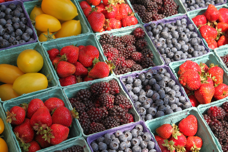 Over the years, local Farmer’s Markets have become increasingly popular. They are great sources for purchasing fresh fruits, vegetables and other food items such as homemade jams, etc.
Depending on where you live (rural or urban town/city), farmer’s markets vary in size, location, times in which they are open and products sold. Some are very small while others are huge. Both offer the opportunity for consumers to purchase freshly grown food items from local farmers. What a great concept!
So, you may ask yourself, why should I shop at a local farmer’s market. There are many different reasons to shop at your local farmer’s market. Here are a few:
- Buying from a local farmer supports local agriculture. This means that the foods we eat come from nearby, and does not require us to waste lots of energy and petroleum to ship the food halfway around the world.
- You can find a variety of fresh, organic produce at more affordable prices than in a supermarket. Many farmers carry products that are not technically “organic,” but have many low-priced foods that are pesticide and herbicide free. The advantage at a farmers market is that you can actually talk to the farmer, learn about their methods, and then decide for yourself.
- Buying locally also means that you are supporting farmers and the local economy. Not only will your money stay in your area, but you will happily please the farmer that worked to grow the food.
- The food from your local farmers market is fresher. Because it was grown locally, there is a good chance that the apple you buy from the farmer was picked a few days ago. This is virtually impossible in a big supermarket.
- There is usually an amazing variety of fruits and veggies at your local farmers market. Each farmer may have his own method for growing tomatoes or peppers. This is something that never happens at a grocery store.
- There is no doubt that locally-grown foods just simply tastes better. You will never be able to eat a carrot from the grocery store again!
- There’s just no way around it, eating fresh, locally-grown fruits and veggies are great for your health.
- Lastly, farmer’s markets are just plain fun for the entire family. Meeting your local community is an excellent way to feel connected to the world around you.
For more information on farmer’s markets and other local food topics, go to the following link: https://localfood.ces.ncsu.edu/
Stephanie
Handwashing: More than just clean hands
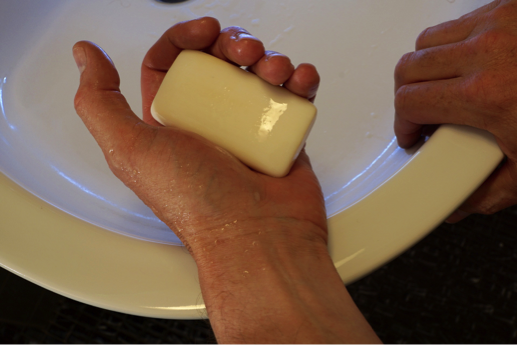
Those of us interested in simple ways to keep our families healthy already know the role proper hand washing plays in preventing the spread of germs. But hand washing plays another role that’s not often considered when fighting the battle to keep families healthy. In that role, hand washing is instrumental in fighting the rise of antibiotic resistance. What’s antibiotic resistance? Well, antibiotic resistance is a bacteria’s ability to survive the effects of the medicine (antibiotic) the doctor prescribes to cure an infection. The bacteria continue to grow, multiply, and eventually spread either in the body or to others.
According to the CDC, hand washing can prevent food borne and other respiratory illnesses like the common cold. Reducing the number of such illnesses reduces the need for and subsequently the overuse of antibiotics. Reducing the overuse, reduces the likelihood resistance will develop. People who suffer from infections that are caused by “resistant” bacteria may require second and third prescriptions from their doctor before the infection is cured. Often the subsequent prescriptions are less effective (the most effective prescription are typically given first) and add to the cost of getting well. Many times, the need for additional prescriptions translates into the need for additional recovery time as well. Such absences can also get pretty ‘costly’ when you consider the time lost when away from work or school.
So, as you can see, as we perform the simple task of washing our hands we’re doing more than just washing away germs. We’re keeping our families and communities healthy by preventing illness, which in turn, preserves antibiotic effectiveness. Read more about how hand washing helps to fight the battle against antibiotic resistance at: http://www.cdc.gov/handwashing/why-handwashing.html. And if you really want to dig deeper, you can read the information found at: http://www.cdc.gov/drugresistance/about.html
Virginia
Keep Your Food Safe This Grilling Season
It’s that time of year! The sounds of laughter and smells of grilling fill the air, as we spend more time outdoors with family and friends.
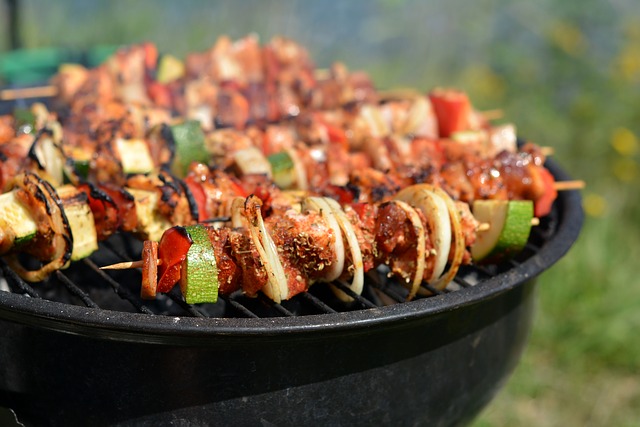
As we gear up for our Memorial Day weekend plans, be aware that bacteria enjoy grilling too! The warm weather is the perfect environment for bacteria to rapidly multiple. Bacteria can lead to food poisoning and cause us to be really sick. Here are helpful tips on how to keep the bacteria and foodborne illness at bay.
- Wash hands with soap and water frequently
- Marinate foods in the refrigerator rather than counter top.
- Keep raw meats, poultry, and seafood separate from raw produce and prepared foods.
- Do not use the same platter and utensil for raw and cooked meats.
- Cook food thoroughly by using a food thermometer to check.
- Keep hot food hot and cold food cold. Avoid the danger zone of 40F-140F.
- Leftover meat and poultry should be refrigerates promptly (within two hours; one hour if the temperature is above 90F).
- Safely refrigerated leftovers can be eaten up to 3-4 days after cooking.
Jasmine
Source: http://www.foodsafety.gov
It's Strawberry Season!
Strawberries are grown year round, but the peak season is right now – April through July. Strawberries are delicious and nutritious. One cup is only 50 calories, has 3 grams of fiber, and contains 100% of the recommended daily allowance of vitamin C.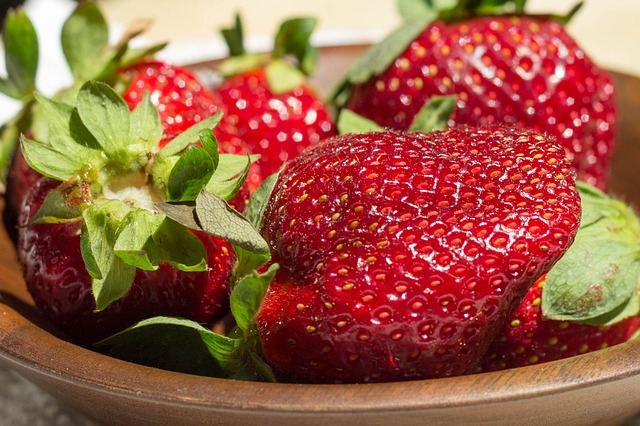
I enjoy the natural sweetness of the strawberries by themselves. They make a quick and healthy snack and don’t need to be refrigerated. Strawberries are also delicious added to fruit smoothies and yogurt and who doesn’t like strawberry shortcake? I even add strawberries to pancakes and waffles instead of maple syrup. They are also a great addition to salads, especially ones made with spinach.
For a fun activity, locate a strawberry farm in your area, and take your children strawberry picking. Choose the strawberries that have a deep red color and are firm and plump, as strawberries do not ripen once picked. Of course, avoid any that have mold. If you pick too many, don’t worry, as you can always freeze the strawberries.
Here are some suggestions for freezing. Wash and gently dry the strawberries. Remove the stems and any berries that are spoiled. Place the berries on a baking sheet, not touching each other and freeze until solid. Transfer to storage containers or plastic freezer bags and store up to six months. Now you can enjoy your strawberries for several more months!
For more information about choosing and storing strawberries, check out our video below.
Resource: http://www.healthyeating.org
More Recipes
Judy
It's Screen Free Week!
It’s Screen-Free Week! What does this mean for you and your family? It’s time to get out of the house and have fun! Try to spend less time in front of the television and more time enjoying each other’s company. Planning fun activities for children can give them something to look forward to and keep them occupied.

Excessive use of electronics can be harmful to a developing child and can lead to health problems later in life, such as obesity, behavioral issues, and irregular sleep patterns. Screen-free week is a great opportunity to teach children the importance of spending time with family, as well as developing healthy habits that will be valuable throughout their life.
Here are some tips that can help you and your family have a successful screen-free week:
• Encourage everyone in the household to commit to going without electronics. This will make it easier for the whole family to get involved in fun activities and spend time together, without the distraction of electronics.
• Make plans so that there is scheduled time to spend with one another. Dedicating a certain amount of time to planned activities can help bond with friends and family. Farm tours and other child-friendly events in the community are a great way to keep the family occupied while learning new things.
• Eat dinner together and talk about what’s been going on throughout the week. It’s a great way to stay involved in each other’s lives and keep one another motivated.
• Involve family and friends in fun activities so that no one is left out from the excitement! Planning a neighborhood cook out is a great way to get to know families in the area.

Summer is right around the corner, which gives us the opportunity to engage in physical activity and enjoy the warmer weather. Farmers markets and local farms are starting to open and crops, such as strawberries, are ready to be harvested. Have some fun with family and friends during screen-free week!
For more information on screen time and screen-free week, check out the following resources: https://www.screenfree.org
Susan